
Ceramic Burner
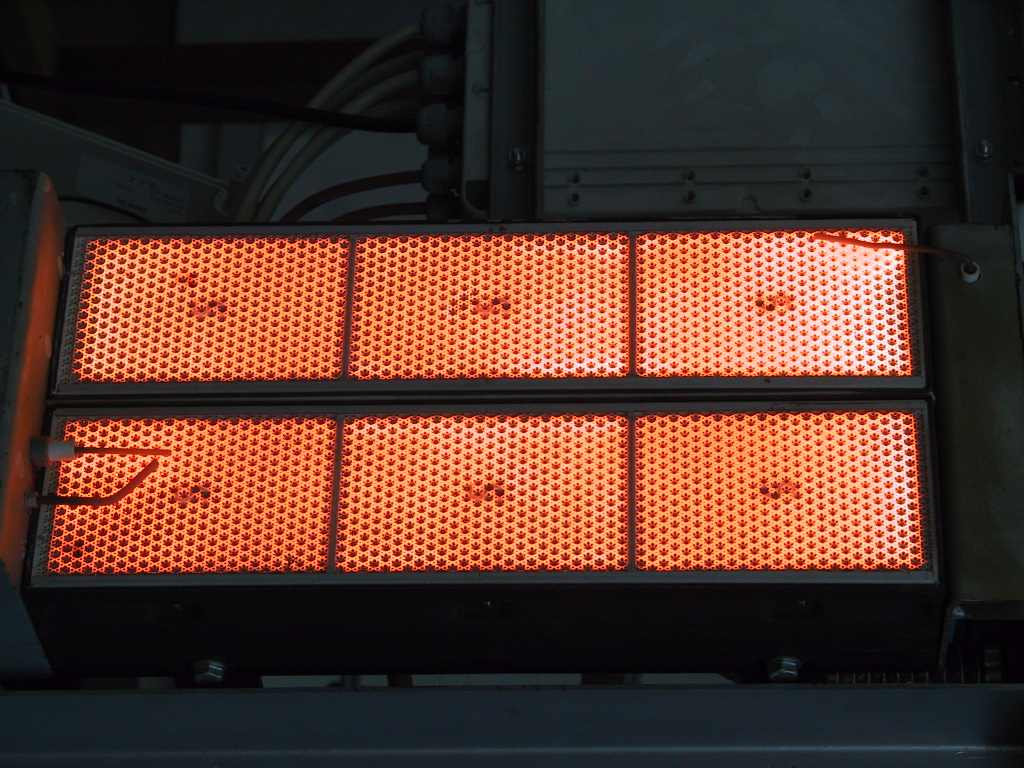
Unlike conventional flame-type burners, the ceramic burner anchors the flame on the surface of a heat-resistant ceramic plate so that combustion happens at the surface rather than as a free flame. This generates a high ratio of infrared radiant heat at low surface temperature (around 1000~1100°C), enabling clean, uniform heating of the target product. NBPKOREA reviews target temperature, residence time, and process geometry to design ceramic burner arrays optimized for each line.
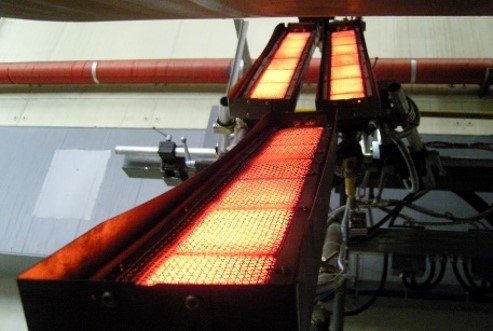
Key Features of the Ceramic Burner
- Surface combustion design — flame fixed on the ceramic plate, eliminating direct flame impingement and product hot-spots
- High infrared radiant heat ratio (typically 50~70%) for fast, energy-efficient heating of the product surface
- Premixed combustion delivers Ultra-Low NOx and CO emissions, well below conventional gas burner levels
- Wide turndown range with quick start-up and shut-down — well suited to intermittent and batch lines
- Compact, low-profile geometry can be tiled into arrays to cover wide oven sections uniformly
- Low convective heat loss → less hot exhaust, reducing fan and exhaust treatment load
- Stable performance with both LNG and LPG; multiple plate sizes available for capacity tuning
- End-to-end support: heat-load review, burner array layout, control integration, commissioning, and maintenance
Applications
Ceramic Combustion Flow
Product Features
Key Capabilities
Heating Mode
Surface Combustion IR
Flame stays on the ceramic surface, transferring heat primarily through infrared radiation rather than convection.
Emissions
Ultra-Low NOx / CO
Premixed combustion at moderate surface temperature suppresses thermal NOx formation.
Thermal Response
Fast Heat-Up / Cool-Down
Low thermal mass at the combustion plate enables rapid temperature change for line conditions.
Layout
Tileable Array
Plates can be combined into arrays to match the oven width and the heat profile required by the process.
Design Considerations
Target Temperature
Ceramic burners are most effective in the low-to-mid temperature range (drying, curing, baking). Above that, hybrid configurations are reviewed.
Heat Distribution
Plate count, spacing, and oven height are tuned to maintain uniform infrared flux across the product surface.
Emission Targets
Excess-air ratio and modulation logic are selected to meet site NOx/CO limits while keeping flame stability.
Control Integration
Modulation, ignition, flame monitoring, and interlocks are matched to the existing PLC / oven control architecture.
Specifications
Ceramic burners are sized by the radiant heat flux required at the product surface, not by raw firing rate alone. Burner plate quantity, layout, and control are designed against oven geometry, target temperature, residence time, and product characteristics.
Application Examples
Considering the Ceramic Burner?
We will propose the optimal specifications for your site conditions.